Galactic Age - Transportation
Contains all Transportation options currently available in the Galactic Age.
Most people use a vehicle or personal transport of some kind these days in order to travel faster or avoid walking.
Transportation
Table of Personal Transportation
| Vehicle | Description | Top Speed (in Meters per Round) | Handling | Size | Armor | HP | Vehicle Modules | Cargo Space | Cost |
|---|---|---|---|---|---|---|---|---|---|
| Bicycle | A two wheeled device that functions by being pedaled and balanced by the user. | 8 Driving | 4 | 2 m | 1 | 20 | None | 5 kg | 15 Credits |
| Skateboard | A four wheeled board that can be easily picked up and carried while not in use. | 7 Driving | 3 | 2 m | 1 | 2 | None | None | 5 Credits |
| Roller Skates | A set of four wheels attached to the bottom of shoe fittings that allows users to skate on any flat surface. While worn: Causes stairs to become Hazardous Terrain with a DC of 12 to avoid falling prone per Movement on said terrain. | 7 Driving | 3 | Small | 1 | 1 | None | None | 2 Credits |
| Roller Blades | A set of 3 to 6 wheels vertically aligned on the bottom of shoe fittings that allows users to quickly skate on any flat surface. While worn: Causes stairs to become Hazardous Terrain with a DC of 12 to avoid falling prone per Movement on said terrain. | 8 Driving | 3 | Small | 1 | 1 | None | None | 2 Credits |
| Wheelbarrow | A single wheel hand cart with two legs to rest on when not in use. | 6 Driving | 3 | 1 m | 3 | 20 | None | 25 kg | 5 Credits |
Table of Land Vehicles
| Vehicle | Top Speed (in 10 Meter Tiles) | Handling (in 10 Meter Tiles) | Size (in Square Meters) | DAPs (Deca Armor Points) | DHPs (Deca Hit Points) | Vehicle Modules | Seats | Cargo Space | Cost | |
|---|---|---|---|---|---|---|---|---|---|---|
| Four-Wheeler | A small four wheeled motorized vehicle with a saddle seat often used for offroading and recreational driving. Uses .25 Liters of Gasoline to operate per minute. | 3 (30 Ms) (108 kph) | 1 | 2 | 0 | 4 | Tiny Gas Engine | 1 | 100 kg. | 40 Credits |
| Go Kart | A small four wheeled motorized vehicle with bucket seat often used for recreational driving. Uses .25 Liters of Gasoline to operate per minute. | 3 (30 Ms) (108 kph) | 1 | 2 | 0 | 3 | Tiny Gas Engine | 1 | 100 kg. | 40 Credits |
| Motor Scooter | Essentially a motorized version of the bicycle. Uses .25 Liters of Gasoline to operate per minute. | 3 (30 Ms) (108 kph) | 1 | 2 | 0 | 3 | Tiny Gas Engine | 1 | 100 kg. | 50 Credits |
| Dirt-Bike | An off-road specialized motorbike. Uses .5 Liters of Gasoline to operate per minute. | 5 (50 Ms) (180 kph) | 2 | 2 | 0 | 3 | Tiny Gas Engine | 1-2 | 50 kg. | 60 Credits |
| Economy Motorcycle | Essentially a motorized version of the bicycle. It is fast and maneuverable but offers little protection for the rider. Uses .5 Liters of Gasoline to operate per minute. | 5 (50 Ms) (180 kph) | 2 | 2 | 0 | 3 | Small Gas Engine | 1-2 | 100 kg. | 200 Credits |
| Roadster Motorcycle | A more comfortable motorcycle for long trips and road driving. Uses 1 Liter of Gasoline to operate per minute. | 5 (50 Ms) (180 kph) | 2 | 2 | 0 | 3 | Small Gas Engine | 1-2 | 100 kg. | 800 Credits |
| Street Motorcycle | A sleek and aerodynamic motorcycle racing and street riding. Uses 1 Liter of Gasoline to operate per minute. | 6 (60 Ms) (216 kph) | 3 | 2 | 0 | 3 | Small Gas Engine | 1-2 | 100 kg. | 1,000 Credits |
| Hoverbike | An advanced hoverbike with two large turbines one in front and one in back. Uses half a 12 Volt Car Battery per minute of flight. Immediately powers down when energy is depleted. | 8 (80 Ms) (288 kph) | 3 | 3 | 0 | 3 | Small Electric Turbine Engine (x2) x3 12 Volt Car Batteries | 50 kg. | 10,000 Credits | |
| Compact Car | A smaller, more economical vehicle. Carries less cargo and passengers than a sedan. Uses .75 Liter of Gasoline to operate per minute. | 5 (50 Ms) (180 kph) | 2 | 6 | 1 | 5 | Small Hybrid Engine | 2 | 200 kg. | 1,000 Credits |
| Sports Car | A smaller, faster and more stylish vehicle, sometimes referred to as a “sports car”. Carries less cargo and passengers than a sedan. Uses 1 Liter of Gasoline to operate per minute. | 6 (60 Ms) (216 kph) | 3 | 8 | 1 | 5 | Large Gas Engine | 3 | 200 kg. | 8,000 Credits |
| Economy Four Door Car | A larger and less stylish vehicle meant to carry many passengers or contained cargo. Uses 1 Liter of Gasoline to operate per minute. | 5 (50 Ms) (180 kph) | 2 | 12 | 1 | 5 | Small Gas Engine | 4 | 400 kg. | 2,000 Credits |
| Four Door Car | A stylish vehicle meant to carry many passengers or contained cargo. Uses 1 Liter of Gasoline to operate per minute. | 5 (50 Ms) (180 kph) | 2 | 12 | 2 | 7 | Medium Gas Engine | 4 | 600 kg. | 8,000 Credits |
| Mini Van | A larger vehicle with a spacious back end that is capable of carrying cargo or a Vehicle Module. Uses 1 Liter of Gasoline to operate per minute. | 5 (50 Ms) (180 kph) | 2 | 16 | 2 | 8 | Medium Gas Engine | 6 | 1,000 kg. | 2,000 Credits |
| Hover Car | A car with four turbines that allows the vehicle to hover or fly short distances. Uses one 12 Volt Car Battery per minute of flight. Immediately powers down when energy is depleted. | 7 (70 Ms) (252 kph) | 3 | 16 | 2 | 8 | Small Electric Turbine Engine (x4) x4 12 Volt Car Batteries | 4 | 400 kg. | 20,000 Credits |
| Pickup Truck | A larger vehicle with a large flat bed in the back that is capable of carrying large amounts of cargo or a Vehicle Module. Uses 1 Liter of Gasoline to operate per minute. | 5 (50 Ms) (180 kph) | 2 | 18 | 2 | 10 | Large Gas Engine | 5 | 2,000 kg. | 3,000 Credits |
| SUV | A larger vehicle with increased seating capacity. Uses 1.5 Liters of Gasoline to operate per minute. | 5 (50 Ms) (180 kph) | 2 | 18 | 2 | 12 | Large Gas Engine | 6 | 1,500 kg. | 4,000 Credits |
| Raised Dually Truck | A larger vehicle with a large flat bed in the back and dual rear wheels that is capable of carrying large amounts of cargo or a Vehicle Module. Uses 2 Liters of Diesel to operate per minute. | 4 (40 Ms) (144 kph) | 2 | 20 | 2 | 16 | Medium Diesel Engine | 5 | 5,000 kg. | 6,000 Credits |
| Delivery Van | A larger vehicle with a spacious back end that is capable of carrying cargo or a Vehicle Module. Uses 1 Liter of Gasoline to operate per minute. | 4 (40 Ms) (144 kph) | 2 | 20 | 2 | 16 | Medium Gas Engine | 3 | 5,000 kg. | 2,000 Credits |
| Delivery Truck | A larger vehicle with a spacious cargo box end that is capable of carrying cargo or a Vehicle Module. Uses 1 Liter of Gasoline to operate per minute. | 4 (40 Ms) (144 kph) | 2 | 30 | 2 | 20 | Large Gas Engine | 3 | 8,000 kg. | 2,500 Credits |
| Hover Truck | A truck with eight turbines that allows the vehicle to hover or fly short distances. Uses 2 12 Volt Car Battery per minute of flight. | 6 (60 Ms) (216 kph) | 3 | 30 | 2 | 20 | Small Electric Turbine Engine (x8) x12 12 Volt Car Batteries | 3 | 5,000 kg. | 5,000 Credits |
| School Bus | A larger vehicle with a spacious back end that features a high number of seats. Uses 2 Liters of Gasoline to operate per minute. | 4 (40 Ms) (144 kph) | 1 | 40 | 2 | 30 | Large Diesel Engine | 40 | 2,000 kg. | 2,500 Credits |
| Semi Truck | A larger vehicle with a tractor trailer hitch on the rear end that allows it to transport Trailers of various lengths. Uses 3 Liters of Diesel to operate per minute. | 4 (40 Ms) (144 kph) | 1 | 60 | 3 | 40 | Large Diesel Engine | 3 | 80,000 kg. | 8,000 Credits |
Table of Sea Vessels
| Vessel | Description | Top Speed (in 100 Meter Tiles) | Turn Speed (in 100 Meter Tiles) | Decks | Size (in sq. Meters) | DAPs Deca Armor Points | Vehicle Modules | Crew | Rooms / Bunks | DHP Deca Hit Points | Cargo Space | Cost |
|---|---|---|---|---|---|---|---|---|---|---|---|---|
| Rowboat | A small rowboat with two paddles. | 1 (10 Ms) | 1 | 1 | 3 | 0 | None | 1 - 2 | None | 3 | 200 kg. | 40 Credits |
| Sailing Pontoon | A small sailing vessel that makes use of 2 or more pontoons and netting. | 2 (20 Ms) (72 kph) | 1 | 1 | 10 | 0 | Small Sail(x2) | 1 - 8 | None | 5 | 300 kg. | 500 Credits |
| Sailing Yacht | A luxurious sailing vessel for the wealthy sailor. | 2 (20 Ms) (72 kph) | 1 | 2 | 30 | 0 | Large Sail | 5 - 10 | 4 / 8 | 8 | 500 kg. | 1,000 Credits |
| Motor Boat | A small modern boat with an outboard gasoline motor. | 4 (40 Ms) (144 kph) | 1 | 1 | 5 | 1 | Medium Gas Engine | 1 - 2 | None | 8 | 300 kg. | 800 Credits |
| Speed Boat | A larger motor boat designed for speed and water racing. | 5 (50 Ms) (180 kph) | 2 | 1 | 7 | 1 | Medium Gas Engine (x2) | 1 - 2 | None | 10 | 300 kg. | 2,000 Credits |
| Smuggling Submarine | A small submarine designed to be used in smuggling operations | 3 (30 Ms) (108 kph) | 1 | 1 | 20 | 2 | Tiny Life Support Unit, Large Diesel Engine, | 2-4 | 2/ 6 | 22 | 1,500 kg. | 10,000 Credits |
| Patrol Craft | A larger motor boat designed for patrols and search and rescue services. | 4 (40 Ms) (144 kph) | 2 | 2 | 50 | 2 | Large Gas Engine, Gatling Turret | 5 - 8 | 4/ 8 | 30 | 1,000 kg. | 2,500 Credits |
| Yacht | A large motorized boat designed for luxury. | 4 (40 Ms) (144 kph) | 1 | 2 | 150 | 2 | Large Diesel Engine (x2) | 2 - 10 | 10 /16 | 15 | 2,500 kg. | 20,000 Credits |
| Mega Yacht | A massive motorized vessel designed for luxury. | 3 (30 Ms) (108 kph) | 1 | 3 | 200 | 2 | Large Diesel Engine (x4) | 20 - 80 | 100 / 160 | 50 | 10,000 kg. | 100,000 Credits |
| Cargo Freighter | A massive motorized vessel designed for cargo transport. | 3 (30 Ms) (108 kph) | 1 | 4 | 1,000 | 2 | Large Diesel Engine (x6) | 10 - 40 | 20 / 40 | 80 | 400 Million kg. | 50,000 Credits |
Table of Aircraft
| Vehicle | Description | Top Speed (in 10 Meter Tiles) | Handling (in 10 Meter Tiles) | Size (in Square Meters) | DAPs (Deca Armor Points) | DHPs (Deca Hit Points) | Vehicle Modules | Crew | Seats | Cargo Space | Cost |
|---|---|---|---|---|---|---|---|---|---|---|---|
| Rocket Pack | A backpack mounted rocket engine. Manually controlled steering vents allow the user of a rocket pack to fly like a bird in the sky. Uses 2 Liters of Rocket Fuel to operate per minute. Immediately shuts down when fuel is depleted. | 8 (80 Ms) (288 kph) | 4 | 1 | 0 | 2 | Rocket Engine(x2) 4 Liter Fuel Tank | 1 | 1 | None | 2,500 Credits |
| Hovercraft | An advanced hovercraft reminiscent of an oversized drone. Uses one 12 Volt Car Battery per minute of flight. Immediately powers down when energy is depleted. | 7 (70 Ms) (252 kph) | 3 | 10 | 0 | 10 | Electric Turbine Engine (x6) x6 12 Volt Car Batteries | 1 | 4 | 100 kg. | 5,000 Credits |
| Single Propeller Plane | A modern propeller airplane with a sleek and aerodynamic design. Uses 3 Liters of Gasoline to operate per minute. | 5 (50 Ms) (180 kph) | 3 | 12 | 1 | 12 | Gasoline Propeller Engine | 1-2 | 4 | 200 kg. | 2,500 Credits |
| Dual Propeller Plane | A modern propeller airplane with a sleek and aerodynamic design. Uses 4 Liters of Gasoline to operate per minute. | 5 (50 Ms) (180 kph) | 3 | 20 | 1 | 14 | Gasoline Propeller Engine(x2) | 1-2 | 8 | 400 kg. | 5,000 Credits |
| Private Jet | An advanced private jetliner with a sleek and aerodynamic design. Uses 4 Liters of Jet Fuel to operate per minute. | 8 (80 Ms) (288 kph) | 3 | 50 | 1 | 18 | Jet Engine | 1-2 | 10 | 600 kg. | 20,000 Credits |
| Fighter Jet | An advanced jet plane with a sleek and aerodynamic design. Uses 2 Liters of Jet Fuel to operate per minute. | 10 (100 Ms) (360 kph) | 5 | 30 | 2 | 22 | Gatling Gun, Flares, Rocket Mounts(6), Jet Engine | 1 | 1 | 100 kg. | 100,000 Credits |
| Passenger Jet | An advanced passenger jetliner with a sleek and aerodynamic design. Uses 6 Liters of Jet Fuel to operate per minute. | 7 (70 Ms) (252 kph) | 3 | 200 | 1 | 30 | Jet Engine(x4) | 1-2 | 50 | 10,000 kg. | 50,000 Credits |
| Cargo Jet | An advanced cargo jetliner with a sleek and aerodynamic design. Uses 6 Liters of Jet Fuel to operate per minute. | 7 (70 Ms) (252 kph) | 3 | 500 | 1 | 36 | Jet Engine(x6) | 1-2 | 6 | 100,000 kg. | 80,000 Credits |
Table of Starships
| Vessel | Top Speed In 100 Meter Tiles | Handling In 100 Meter Tiles | Decks | Size In sq. Meters | Deca HP | Armor | Starship Modules | Crew | Rooms / Bunks / Seats | Cargo Space | Cost |
|---|---|---|---|---|---|---|---|---|---|---|---|
| Personal Transport Craft | 10 (1,000 Ms) (3,600 kph) | 2 | 1 | 20 | 20 | 1 | Small Rocket Engine(x2), Tiny Life Support Unit, Tiny Fusion Reactor | 1 | 1 / 1 | 500 kg. | 120,000 Credits |
| Tug Freighter Craft | 12 (1,200 Ms) (4,320 kph) | 3 | 1 | 50 | 35 | 1 | Small Rocket Engine(x3), Tiny Life Support Unit, Tiny Fusion Reactor, MII Slip Drive | 1-2 | 1 / 2 | 10,000 kg. | 140,000 Credits |
| Passenger Craft | 10 (1,000 Ms) (3,600 kph) | 2 | 2 | 400 | 50 | 1 | Medium Rocket Engine(x2), Small Life Support Unit, Small Fusion Reactor, MII Slip Drive | 6 | 2 / 6 / 40 | 50,000 kg. | 2 Million Credits |
| Cargo Freighter Craft | 10 (1,000 Ms) (3,600 kph) | 2 | 3 | 1,000 | 100 | 1 | Medium Rocket Engine(x2), Tiny Life Support Unit, Small Fusion Reactor, MI Slip Dive | 5 | 3 / 6 / 10 | 1 Million kg. | 3 Million Credits |
| Military Fighter Craft | 14 (1,400 Ms) (5,040 kph) | 5 | 1 | 20 | 22 | 2 | Small Rocket Engine(x2), Tiny Fusion Reactor, Gatling Gun, Rocket Mount(x4), Micro Shield Generator | 1 | None | 100 kg. | 5 Million Credits |
| Military Destroyer | 11 (1,100 Ms) (3,960 kph) | 3 | 2 | 200 | 80 | 3 | Medium Rocket Engine(x2), Small Life Support Unit, Small Fusion Reactor, Blaster Turret(x4), Torpedo Tube(x2) MII Slip Drive, Small Shield Generator | 10 | 5 / 10 / 10 | 50,000 kg. | 12 Million Credits |
| Military Cruiser | 10 (1,000 Ms) (3,600 kph) | 2 | 3 | 500 | 180 | 4 | Medium Rocket Engine(x2), Small Life Support Unit, Medium Fusion Reactor, Blaster Turret(x8), Torpedo Tube(x4), Beam Cannon(x2) MII Slip Drive, Medium Shield Generator | 50 | 30 / 60 / 80 | 80,000 kg. | 25 Million Credits |
Starship Modules
Starship modules are what make up to various sections and components of a starship. A starship would not be one without the essential modules that make up a ship. These modules can be used to build a ship from scratch or modify a pre-existing vessel.
Starship Modules Table
| System Name | Function | Range | Skill + | Power Req. | Size | Cost | HP |
|---|---|---|---|---|---|---|---|
| Polysteel Hull | 2 Starship Armor, AC +1, Tiny or larger vessel required. | - | - | - | N/A | 10,000 Credits | 1 |
| Titanium Hull | 4 Starship Armor, AC +2, Tiny or larger vessel required. | - | - | - | N/A | 20,000 Credits | 2 |
| Starsteel Hull | 8 Starship Armor, AC +4, Small or larger vessel required. | - | - | - | N/A | 40,000 Credits | 4 |
| Supersteel Hull | 12 Starship Armor, AC +6, Medium or larger vessel required. | - | - | - | N/A | 80,000 Credits | 6 |
| Megasteel Hull | 16 Starship Armor, AC +8, Large or larger vessel required. | - | - | - | N/A | 160,000 Credits | 8 |
| Ultrasteel Hull | 20 Starship Armor, AC +10, Huge or larger vessel required. | - | - | - | N/A | 300,000 Credits | 10 |
| Reactive Hull | 20 Starship Armor, AC +10, Small or larger vessel required. | - | - | 2 GW | N/A | 300,000 Credits | 6 |
| Starship Frame Type I | The building block and requirement to start adding modules to consumer grade star vessels. | - | - | 10m | 20,000 Credits | 2 | |
| Starship Frame Type II | The building block and requirement to start adding modules to commercial grade star vessels. | - | - | - | 10m | 30,000 Credits | 4 |
| Starship Frame Type III | The building block and requirement to start adding modules to military grade star vessels. | - | - | - | 10m | 50,000 Credits | 8 |
| Airlock (Standard) | A multi-sequence 2 door airlock that can interface with any other standard airlock. | - | - | .5 GW | 2m | 10,000 Credits | 2 |
| Airlock (Standard) (Breaching) | A multi-sequence 2 door airlock that can interface with any other standard airlock. It possesses a motorized arm and beam welder that cut through other standard airlock doors. | - | - | 2 GW | 2m | 30,000 Credits | 2 |
| Blast Doors | A set of blast doors. The doors have reinforced armor and a magnetic seal. They are considered to be impenetrable by conventional arms and typically require explosives to open forcefully. Can be activated from the door panel or from the bridge with the proper authorization. | - | - | .5 | 2m | 20,000 Credits | 4 |
| Boarding Ramp(Small) | A small extendible boarding ramp that is typically situated on the underside of the vessel. It often leads directly into the cargo hold area of the vessel and allows for efficient loading and unloading of the vessel. | - | - | .5 GW | 2x1 meter opening | 10,000 Credits | 2 |
| Boarding Ramp(Standard) | A standard size extendible boarding ramp that is typically situated on the underside of the vessel. It often leads directly into the cargo hold area of the vessel and allows for efficient loading and unloading of the vessel. | - | - | .5 GW | 4x2 meter opening | 20,000 Credits | 4 |
| Boarding Ramp(Large) | A large extendible boarding ramp that is typically situated on the underside of the vessel. It often leads directly into the cargo hold area of the vessel and allows for efficient loading and unloading of the vessel. | - | - | .5 GW | 8x4 meter opening | 40,000 Credits | 6 |
| Boarding Ramp(XL) | An extra large extendible boarding ramp that is typically situated on the underside of the vessel. It often leads directly into the cargo hold area of the vessel and allows for efficient loading and unloading of the vessel. | - | - | .5 GW | 16x8 meter opening | 80,000 Credits | 8 |
| Cargo Hold Deck | A section of cargo hold that can be combined into nearly any configuration. Unfurnished and barely lit. | - | - | .01 | 1 sq. meter | 50 Credits per sq. meter | - |
| Command Deck | A section of the command deck that can be combined into nearly any configuration. Features additional power and connection plugs and thicker bulkheads. Sparsely furnished and well lit. | - | - | .04 | 1 sq. meter | 120 Credits per sq. meter | - |
| Corridor Deck | A section of corridor that can connect various sections of a starship. Sparsely furnished and dimly lit. | .01 | 1 sq. meter | 75 Credits per sq. meter | - | ||
| Airlock (Standard) (Large) | A multi-sequence 2 door airlock that can interface with any other standard airlock. It is double the size of a standard airlock, so larger creatures and cargo can enter through the passage. | - | - | .5 GW | 4m | 20,000 Credits | 4 |
| Cloak Field Generator | Renders all parts of the vessel within the area visually invisible and undetectable via scans that originate outside of the cloaking field. | 10 tiles | - | 5GW | 4m | 400,000 Credits | 5 |
| Scanning Insulation | Prevents scans from penetrating into the insulated area. The scan will instead reveal a void in the insulated area. | 1 tile | - | - | 10m | 50,000 Credits | 1 |
| Comms Hub Type I | Long range communications | 25 tiles | - | 1GW | 1m | 10,000 Credits | 3 |
| Comms Hub Type II | Long range communications | 50 tiles | - | 2GW | 4m | 25,000 Credits | 4 |
| Comms Hub Type III | Long range communications | 150 tiles | - | 5GW | 10m | 50,000 Credits | 4 |
| Booster Rocket Type I | Generation of Speed and cargo capacity, +1 speed / + 1 c | - | - | 1GW | 2m | 5,000 Credits | 5 |
| Booster Rocket Type II | Generation of Speed and cargo capacity, +2 speed / + 2 c | - | - | 2GW | 3m | 10,000 Credits | 10 |
| Booster Rocket Type III | Generation of Speed and cargo capacity,+3 speed / + 3 c | - | - | 3GW | 4m | 25,000 Credits | 15 |
| Engineering Hub Type I | Regulating power flow and overseeing repairs | - | - | .5GW | 1m | 10,000 Credits | 5 |
| Engineering Hub Type II | Regulating power flow and overseeing repairs | - | +2 | 1GW | 2m | 25,000 Credits | 8 |
| Engineering Hub Type III | Regulating power flow and overseeing repairs | - | +4 | 2GW | 2m | 50,000 Credits | 11 |
| Fuel Tank Type I | Safe storage of vessel’s fuel supply, 5 Units | - | - | - | 4m | 10,000 Credits | 5 |
| Fuel Tank Type II | Safe storage of vessel’s fuel supply, 10 Units | - | - | - | 6m | 25,000 Credits | 8 |
| Fuel Tank Type III | Safe storage of vessel’s fuel supply, 20 Units | - | - | - | 10m | 50,000 Credits | 12 |
| Fusion Power Core Type I | Generation of power | - | - | -10GW | 6m | 10,000 Credits | 8 |
| Fusion Power Core Type II | Generation of power | - | - | -22GW | 10m | 25,000 Credits | 12 |
| Fusion Power Core Type III | Generation of power | - | - | -33GW | 20m | 50,000 Credits | 16 |
| Fusion Power Coil Type I | Converts power into fuel at a rate of 1 GW to 1 Unit(s) of fuel every 12 hours. | - | - | 1GW | 3m | 5,000 Credits | 5 |
| Fusion Power Coil Type II | Converts power into fuel at a rate of 2 GW to 2 Unit(s) of fuel every 12 hours. | - | - | 2GW | 5m | 10,000 Credits | 7 |
| Fusion Power Coil Type III | Converts power into fuel at a rate of 3 GW to 3 Unit(s) of fuel every 12 hours. | - | - | 3GW | 10m | 20,000 Credits | 10 |
| Habitat Deck | A section of habitable living space that can be arranged into any configuration. Comfortably furnished and well lit. | .02 | 1 sq. meter | 100 Credits per sq. meter | - | ||
| Kitchenette | All utilities needed for the preparation and cooking of food | - | - | .25GW | 2m | 3,000 Credits | 4 |
| Kitchen | All utilities needed for the preparation and cooking of food as well as ample space to store and freeze foodstuffs. | - | +1 | .50GW | 4m | 10,000 Credits | 5 |
| Mess | All utilities needed for the preparation and cooking of large volumes of food as well as ample space to store and freeze foodstuffs and seat diners. | - | +2 | 1GW | 10m | 25,000 Credits | 8 |
| Life Support Type I | Generation and ample flow of breathable air | 1 tiles | - | 1GW | 2m | 10,000 Credits | 4 |
| Life Support Type II | Generation and ample flow of breathable air | 2 tiles | - | 2GW | 4m | 25,000 Credits | 6 |
| Life Support Type III | Generation and ample flow of breathable air | 5 tiles | - | 3GW | 6m | 50,000 Credits | 8 |
| Maneuvering Jets Type I | Increases the vessels maneuverability, +1 handling | - | - | 1GW | 1m | 4,000 Credits | 2 |
| Maneuvering Jets Type II | Increases the vessels maneuverability, +2 handling | - | - | 2GW | 2m | 10,000 Credits | 3 |
| Maneuvering Jets Type III | Increases the vessels maneuverability, +3 handling | - | - | 2.5GW | 4m | 20,000 Credits | 5 |
| Mini Med Bay | Allows for rapid recovery from wounds and illnesses, x 2 heal rate during extended rests in med bay, +4 on Medicine Skill Rolls made in med bay. | - | +5 | 1GW | 4m | 15,000 Credits | 4 |
| Med Bay | Allows for rapid recovery from wounds and illnesses, x 2 heal rate during extended rests in med bay, +5 and add a Destiny Die on Medicine Skill Rolls in the med bay. | - | +5 | 2GW | 8m | 30,000 Credits | 6 |
| Med Suite | Allows for rapid recovery from wounds and illnesses, x 3 heal rate during extended rests in med bay, +8 and add a Destiny Die on Medicine Skill Rolls in the med bay. | - | +8 | 4GW | 10m | 80,000 Credits | 8 |
| Navigations Hub Type I | Allows for the plotting of Slipstream Routes | 2 Star Systems | +1 | 1GW | 1m | 12,000 Credits | 3 |
| Navigations Hub Type II | Allows for the plotting of Slipstream Routes | 3 Star Systems | +2 | 2GW | 2m | 25,000 Credits | 4 |
| Navigations Hub Type III | Allows for the plotting of Slipstream Routes | 4 Star Systems | +3 | 2.5GW | 4m | 85,000 Credits | 6 |
| Pilot’s SuiteType I | Allows for the controlling and maneuvering of the vessel from the suite. | - | - | .5GW | 1m | 5,000 Credits | 3 |
| Pilot’s SuiteType II | Allows for the controlling and maneuvering of the vessel from the suite. | - | +1 | 1GW | 2m | 15,000 Credits | 5 |
| Pilot’s SuiteType III | Allows for the controlling and maneuvering of the vessel from the suite. | - | +2 | 1.5GW | 3m | 35,000 Credits | 7 |
| Slip Drive Type I | Allows the ship to access the slipstream and travel faster than the speed of light between star systems. | 1 Star System | - | 5GW | 2m | 98,000 Credits | 8 |
| Slip Drive Type II | Allows the ship to access the slipstream and travel faster than the speed of light between star systems. | 2 Star Systems | - | 7GW | 4m | 180,000 Credits | 10 |
| Slip Drive Type III | Allows the ship to access the slipstream and travel faster than the speed of light between star systems. | 4 Star Systems | - | 10GW | 6m | 400,000 Credits | 12 |
| Grav Drive | Allows the ship to instantly teleport between massive gravity fields. The bigger the field, the further the distance the grav drive can teleport. This makes the drive useless in deep space but able to travel between suns and black holes faster than most forms of FTL. | 1-5 Star Systems | - | 10GW | 6m | 300,000 Credits | 12 |
| Small Replicator | Allows for the replication of common scanned items and food as long as matter banks are full. Each print uses 1 charge from the matter banks, the matter banks have 30 charges and the cost to refill is 3g. Items and food cannot be larger than 1 sq. meter. Can replicate scanned common poisons and potions. | - | - | 1GW | 3m | 12,000 Credits | 1 |
| Medium Replicator | Allows for the replication of common scanned items and food as long as matter banks are full. Each print uses 1 charge from the matter banks, the matter banks have 30 charges and the cost to refill is 5g. Items and food cannot be larger than 2 sq. meter. Can replicate scanned common poisons and potions. | - | - | 2GW | 5m | 25,000 Credits | 3 |
| Large Replicator | Allows for the replication of common scanned items, object machines and food as long as matter banks are full. Each print uses 1 charge from the matter banks, the matter banks have 20 charges and the cost to refill is 10g. Items and food cannot be larger than 5 sq. meter. Can replicate scanned common poisons and potions. | - | - | 5GW | 12m | 85,000 Credits | 6 |
| Pulse - Sensor Suite Type I | Short range scanning - Range: 10 Tiles | 10 tiles | - | 1GW | 1m | 10,000 Credits | 3 |
| Pulse - Sensor Suite Type II | Short range scanning - Range: 15 Tiles | 15 tiles | - | 2GW | 3m | 25,000 Credits | 5 |
| Pulse - Sensor Suite Type III | Short range scanning - Range: 20 Tiles | 20 tiles | - | 3GW | 6m | 55,000 Credits | 7 |
| Multi-Spectrum- Sensor Suite Type I | Long range scanning - Range: 1 System | 1 Star System | - | 5GW | 2m | 16,000 Credits | 4 |
| Multi-Spectrum- Sensor Suite Type II | Long range scanning - Range: 2 Systems | 2 Star Systems | - | 7GW | 5m | 36,000 Credits | 6 |
| Multi-Spectrum- Sensor Suite Type III | Long range scanning - Range: 3 Systems | 3 Star Systems | - | 10GW | 10m | 98,000 Credits | 10 |
| Shield Emitter Type I | Generation of shield around vessel, 20 shield capacity / 3 rr | - | - | 2GW | 1m | 10,000 Credits | 4 |
| Shield Emitter Type II | Generation of shield around vessel, 40 shield capacity / 5 rr | - | - | 5GW | 5m | 25,000 Credits | 8 |
| Shield Emitter Type III | Generation of shield around vessel, 60 shield capacity / 8 rr | - | - | 8GW | 10m | 95,000 Credits | 12 |
| Torpedo Tube Type I | Allows for the firing and reloading of Type I Torpedos | - | - | .5GW | 2m | 50,000 Credits | 3 |
| Torpedo Tube Type II | Allows for the firing and reloading of Type II Torpedos | - | - | 1GW | 6m | 15,000 Credits | 5 |
| Torpedo Tube Type III | Allows for the firing and reloading of Type III Torpedos | - | - | 2GW | 10m | 40,000 Credits | 8 |
| Weapons Hub Type I | Firing and reloading connected weapons systems, limit 4 weapon system connections. | - | - | .5GW | 1m | 5,000 Credits | 5 |
| Weapons Hub Type II | Firing and reloading connected weapons systems, limit 8 weapon system connections. | - | +1 | 1GW | 3m | 15,000 Credits | 7 |
| Weapons Hub Type III | Firing and reloading connected weapons systems, limit 12 weapon system connections. | - | +2 | 2GW | 5m | 40,000 Credits | 10 |
| Gav Field Generator Type I | Generates artificial gravity for up to 1 Hectometer. | 1 ton | - | 1GW | 2m | 25,000 Credits | 3 |
| Gav Field Generator Type II | Generates artificial gravity for up to 2 Hectometers. | 2 tons | - | 2GW | 5m | 50,000 Credits | 5 |
| Gav Field Generator Type III | Generates artificial gravity for up to 5 Hectometers. | 5 tons | - | 4GW | 10m | 120,000 Credits | 8 |
| Landing Gear Type I | Allows small vessels to land on various flat surfaces. | 1-2 tons | - | .25GW | 2m | 5,000 Credits | 4 |
| Landing Gear Type II | Allows medium sized vessels to land on various flat surfaces. | 3-5 tons | - | .5GW | 8m | 25,000 Credits | 8 |
| Landing Gear Type III | Allows large vessels to land on various flat surfaces. | 5-10 tons | - | 1GW | 12m | 85,000 Credits | 12 |
| Magnetic Clamps | Allows the ships landing gear to electromagnetically attach to ferrous metal surfaces, such as the hulls of larger vessels. Suitable for non-capital ships only. | - | - | 1GW | 1m | 15,000 Credits | 4 |
| Weapons Port Type I | Allows for Personal scale weapons to be mounted in that location and be fed power. | - | - | - | 1M | 5,000 Credits | 2 |
| Weapons Port Type II | Allows for Fighter scale weapons to be mounted in that location and be fed power. | - | - | - | 2M | 10,000 Credits | 4 |
| Weapons Port Type III | Allows for Capital scale weapons to be mounted in that location and be fed power. | - | - | - | 9M | 25,000 Credits | 6 |
Weapons Modules
A craft's weapons section indicates how many instances of destructive weapons are available onboard and the amount and type of damage those weapons deal on the large scale. Weapon range is listed in 100 Meter tiles.
Array of Weapons
Some weapons are arranged in an array so that they can be easily utilized by a single user. Weapon arrays typically are multiple weapon systems of the same type. They all use the same targeting controls and vectors and can therefore all be fired together using a single Action. Arrays are noted in the weapons section of the Card of the Vessel with a “x” symbol and then a number following indicating the number of weapon systems in that array.
Weapon Modules Table
This section explores various examples for weapons systems and arrays intended for integration with starships.
| Name | Description | Ammo / Reload | Range in Hectometers | Damage | Dam. Type | Weapon Type | Space Req. | Power Req. | Cost | Hecta HP |
|---|---|---|---|---|---|---|---|---|---|---|
| Plasma Blaster Turret Type I (dual) | A manually operated dual plasma blaster turret that completely bypasses kinetic shields. | Large Plasma Cartridge (100 Shots) | 4 | 2d4+2 | Burn | Fighter | 2 Cubic Meters | 1 GW | 10,000 Credits | 2 |
| Plasma Blaster Turret Type II (quad) | A manually operated quad plasma blaster turret. | Large Plasma Cartridge (50 Shots) | 4 | 4d4+2 | Burn | Fighter | 3 Cubic Meters | 1.5 GW | 20,000 Credits | 4 |
| Plasma Blaster Turret Type III (Gatling) | A manually operated gatling plasma blaster turret. | Large Plasma Cartridge (30 Shots) | 4 | 6d4+2 | Burn | Fighter | 4 Cubic Meters | 2 GW | 60,000 Credits | 6 |
| Harpoon Turret Type I | A manually operated harpoon turret, complete with winch system. Each Harpoon can hold 1,000 kg of weight on the cable. | Starship Harpoon (1 Shot) | 2 | 1d8 | Puncture | Fighter | 2 Cubic Meters | .5 GW | 7,000 Credits | 2 |
| Harpoon Turret Type II | A large manually operated harpoon turret, complete with winch system. Each Harpoon can hold 2,500 kg of weight on the cable. | Starship Harpoon (1 Shot) | 3 | 1d10 | Puncture | Fighter | 3 Cubic Meters | 1 GW | 14,000 Credits | 4 |
| Harpoon Turret Type III | A massive manually operated harpoon turret, complete with winch system. Each Harpoon can hold 5,000 kg of weight on the cable. | Starship Harpoon (1 Shot) | 4 | 1d12 | Puncture | Fighter | 4 Cubic Meters | 1.5 GW | 21,000 Credits | 6 |
| Rail Gun Turret Type I | A manually operated rail gun turret that completely bypasses energy shields. | Mag Bolt (1 Shot) | 6 | 2d6 | Puncture | Fighter | 2 Cubic Meters | 1 GW | 15,000 Credits | 1 |
| Rail Gun Turret Type II | A large manually operated rail gun turret that completely bypasses energy shields. | Mag Bolt (1 Shot) | 8 | 2d8 | Puncture | Fighter | 4 Cubic Meters | 2 GW | 30,000 Credits | 2 |
| Rail Gun Turret Type III | A massive manually operated rail gun turret that completely bypasses energy shields. | Mag Bolt (1 Shot) | 10 | 2d10 | Puncture | Fighter | 8 Cubic Meters | 4 GW | 50,000 Credits | 4 |
| Plasma Blaster Cannons Type I | A Plasma Blaster Cannon Battery designed for capital ship scale combat. | Large Plasma Cartridge (50 Shots) | 6 | 2d6+2 | Burn | Fighter | 4 Cubic Meters | 2 GW | 15,000 Credits | 2 |
| Plasma Blaster Cannons Type II | A large Plasma Blaster Cannon Battery designed for capital ship scale combat. | Large Plasma Cartridge (50 Shots) | 6 | 2d6+4 | Burn | Fighter | 5 Cubic Meters | 2.5 GW | 30,000 Credits | 3 |
| Plasma Blaster Cannons Type III | A massive Plasma Blaster Cannon Battery designed for capital ship scale combat. | Large Plasma Cartridge (30 Shots) | 6 | 2d8+4 | Burn | Fighter | 6 Cubic Meters | 3 GW | 50,000 Credits | 4 |
| Rail Gun Type I | A capital ship scale railgun that completely bypasses energy shields. | Mag Bolt (1 Shot) | 7 | 1d10+2 | Puncture | Fighter | 4 Cubic Meters | 2 GW | 20,000 Credits | 2 |
| Rail Gun Type II | A large capital ship scale railgun that completely bypasses energy shields. | Mag Bolt (1 Shot) | 8 | 1d12+2 | Puncture | Fighter | 6 Cubic Meters | 3 GW | 40,000 Credits | 3 |
| Rail Gun Type III | A massive capital ship scale railgun that completely bypasses energy shields. | Mag Bolt (1 Shot) | 9 | 1d20+2 | Puncture | Fighter | 8 Cubic Meters | 4 GW | 60,000 Credits | 4 |
| Ion Cannon Type I | A capital ship scale ion cannon designed to damage and disable energy shields. | Ion Cell (10 Shots) | 5 | 2d8 | Electrical | Capital Ship | 10 Cubic Meters | 5 GW | 40,000 Credits | 3 |
| Ion Cannon Type II | A large capital ship scale ion cannon designed to damage and disable energy shields. | Ion Cell (5 Shots) | 10 | 2d10 | Electrical | Capital Ship | 15 Cubic Meters | 8 GW | 80,000 Credits | 5 |
| Ion Cannon Type III | A massive capital ship scale ion cannon designed to damage and disable energy shields. | Ion Cell (2 Shots) | 20 | 2d12 | Electrical | Capital Ship | 20 Cubic Meters | 12 GW | 120,000 Credits | 7 |
| Mega-Rail Gun Type I | A gargantuan capital ship scale railgun that completely bypasses energy shields. | Mega Mag Bolt (1 Shot) | 8 | 2d8+1 | Puncture | Capital Ship | 8 Cubic Meters | 4 GW | 30,000 Credits | 3 |
| Mega-Rail Gun Type II | A titanious capital ship scale railgun that completely bypasses energy shields. | Mega Mag Bolt (1 Shot) | 10 | 2d10+1 | Puncture | Capital Ship | 10 Cubic Meters | 6 GW | 60,000 Credits | 4 |
| Mega-Rail Gun Type III | A megalithic capital ship scale railgun that completely bypasses energy shields. | Mega Mag Bolt (1 Shot) | 12 | 2d12+1 | Puncture | Capital Ship | 12 Cubic Meters | 8 GW | 90,000 Credits | 5 |
| Particle Accelerator Cannon Type I | A Particle Accelerator Cannon Battery designed for capital ship scale combat. High damage and extremely precise. | Photon Particle Canister (5 Shots) | 10 | 2d12+2 | Kinetic | Capital Ship | 10 Cubic Meters | 5 GW | 80,000 Credits | 4 |
| Particle Accelerator Cannon Type II | A large Particle Accelerator Cannon Battery designed for capital ship scale combat. High damage and extremely precise. | Photon Particle Canister (3 Shots) | 12 | 2d12+4 | Kinetic | Capital Ship | 12 Cubic Meters | 7 GW | 160,000 Credits | 6 |
| Particle Accelerator Cannon Type III | A massive Particle Accelerator Cannon Battery designed for capital ship scale combat. High damage and extremely precise. | Photon Particle Canister (2 Shots) | 14 | 2d12+6 | Kinetic | Capital Ship | 14 Cubic Meters | 9 GW | 240,000 Credits | 8 |
| Blaster Cannon Array Type I | An array of capital ship scale plasma blaster cannons best suited for broadsides and barrages. | Mega Plasma Cartridge (30 Shots) | 6 | 4d6 + 2 | Burn | Capital Ship | 10 Cubic Meters | 6 GW | 75,000 Credits | 4 |
| Blaster Cannon ArrayType II | A large array of capital ship scale plasma blaster cannons best suited for broadsides and barrages. | Mega Plasma Cartridge (15 Shots) | 7 | 5d6 + 2 | Burn | Capital Ship | 12 Cubic Meters | 7 GW | 150,000 Credits | 6 |
| Blaster Cannon ArrayType III | A massive array of capital ship scale plasma blaster cannons best suited for broadsides and barrages. | Mega Plasma Cartridge (8 Shots) | 8 | 6d6 + 2 | Burn | Capital Ship | 14 Cubic Meters | 8 GW | 220,000 Credits | 8 |
| Disruptor Array Type I | An array of capital ship scale disruptor cannons best suited for broadsides and barrages. | Antimatter Stasis Cell (5 Shots) | 7 | 3d8 | Kinetic | Capital Ship | 10 Cubic Meters | 8 GW | 90,000 Credits | 3 |
| Disruptor Array Type II | A large array of capital ship scale disruptor cannons best suited for broadsides and barrages. | Antimatter Stasis Cell (3 Shots) | 8 | 4d8 | Kinetic | Capital Ship | 12 Cubic Meters | 10 GW | 180,000 Credits | 5 |
| Disruptor Array Type II | A massive array of capital ship scale disruptor cannons best suited for broadsides and barrages. | Antimatter Stasis Cell (2 Shots) | 9 | 4d10 | Kinetic | Capital Ship | 14 Cubic Meters | 12 GW | 240,000 Credits | 7 |
| Photonic Torpedo Type I | A highly advanced and sophisticated compressed photon based warhead for use in capital scale combat. | - | 12 | 8d8+8 | Burn | Capital Ship | 2 Cubic Meters | - | 10,000 Credits | 2 |
| Photonic Torpedo Type II | A highly advanced and sophisticated compressed photon based warhead with an increased destructive load for use in capital scale combat. | - | 14 | 8d10+10 | Burn | Capital Ship | 4 Cubic Meters | - | 25,000 Credits | 3 |
| Photonic Torpedo Type III | A highly advanced and sophisticated compressed photon based warhead with an drastically increased destructive load for use in capital scale combat. | - | 16 | 8d12+12 | Burn | Capital Ship | 6 Cubic Meters | - | 50,000 Credits | 4 |
| Thermo- Nuclear Torpedo Type I | A crude thermo - nuclear based warhead intended for use in capital scale combat. | - | 10 | 3d20+10 | Burn / Toxic ( Radiation ) | Capital Ship | 2 Cubic Meters | - | 8,000 Credits | 2 |
| EMP Torpedo Type I | A warhead that generates a powerful electro - magnetic pulse that can disable starship systems. | - | 12 | 6d6+6 | Electrical | Capital Ship | 2 Cubic Meters | - | 12,000 Credits | 2 |
| EMP Torpedo Type II | A large warhead that generates a powerful electro - magnetic pulse that can disable starship systems. | - | 14 | 6d8+8 | Electrical | Capital Ship | 4 Cubic Meters | - | 30,000 Credits | 4 |
| EMP Torpedo Type III | A massive warhead that generates a powerful electro - magnetic pulse that can disable starship systems. | - | 16 | 6d10+10 | Electrical | Capital Ship | 6 Cubic Meters | - | 60,000 Credits | 6 |
| Leech Torpedo Type I | Drains 2d6 GW R1 Can be recovered and used as power or stored. | - | 12 | N/A | - | Capital Ship | 2 Cubic Meters | - | 10,000 Credits | 2 |
| Leech Torpedo Type II | Drains 2d6 GW R1 Can be recovered and used as power or stored. | - | 14 | N/A | - | Capital Ship | 4 Cubic Meters | - | 20,000 Credits | 4 |
| Leech Torpedo Type III | Drains 2d6 GW R1 Can be recovered and used as power or stored. | - | 16 | N/A | - | Capital Ship | 6 Cubic Meters | - | 40,000 Credits | 6 |
Starship Weapons Ammunition Table
| Name | Description | Weapon Type | Space Req. | Hecta HP | Cost |
|---|---|---|---|---|---|
| Antimatter Stasis Cell | A stasis cell containing a small amount of antimatter | Disruptors | 1 Cubic Meter | 1 | 5,000 Credits |
| Photon Particle Canister | A technologically advanced canister capable of housing accelerated Photons | Particle Accelerators | 2 Cubic Meters | 1 | 5,000 Credits |
| Large Plasma Cartridge | A large cartridge of superheated plasma ready for use in any fighter scale Plasma Blaster weaponry | Fighter Scale Plasma Blasters | 1 Cubic Meter | 1 | 10,000 Credits |
| Mega Plasma Cartridge | A massive cartridge of superheated plasma ready for use in any capital scale Plasma Blaster weaponry | Capital Ship Scale Plasma Blasters | 2 Cubic Meters | 1.5 | 15,000 Credits |
| Mag Bolt | A large magnetic projectile designed for use in fighter scale Rail Gun | Fighter Scale Rail Guns | .25 Cubic Meters | .25 | 100 Credits |
| Mega Mag Bolt | A massive magnetic projectile designed for use in capital scale Rail Gun | Capital Ship Scale Rail Guns | .50 Cubic Meters | .50 | 300 Credits |
| Ion Cell | A secure storage capsule capable of housing Ionized Particles that generate a EMP Blast once charged with sufficient power | Ion Cannons | 1 Cubic Meter | 1 | 5,000 Credits |
| Starship Harpoon | A large and extremely durable harpoon with attached diamond filament cable that is capable of puncturing starship hulls and can be used to slow, drag or manipulate starships with enough thruster force generated. The harpoon can be recovered after firing. | Harpoons | 2 Cubic Meters | 2 | 1,000 Credits |
Facing of Weapons
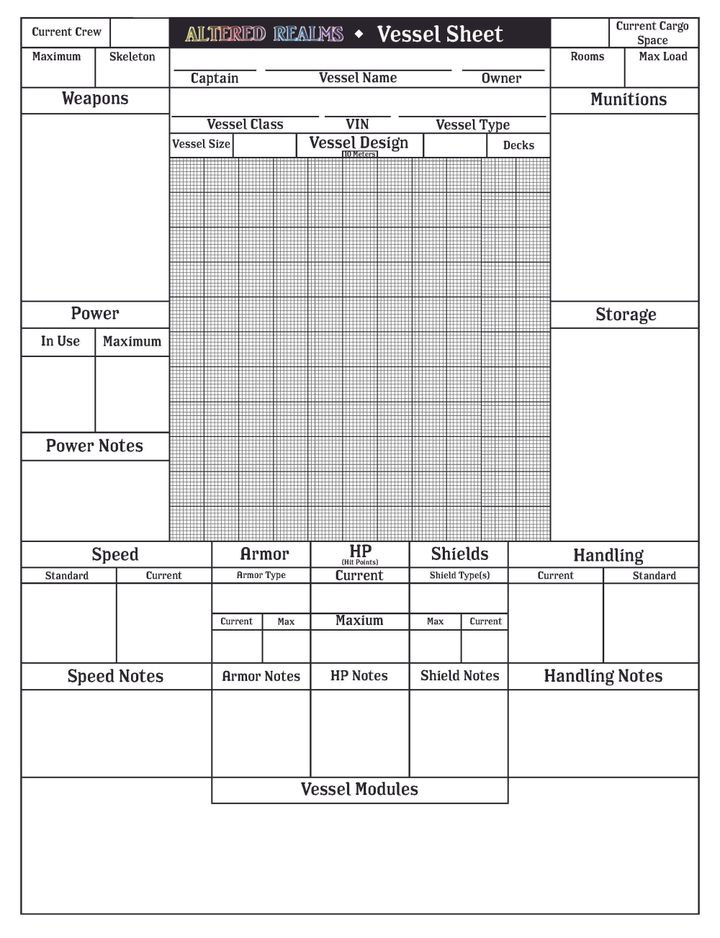
Many vessels have a particular orientation ideal for firing certain weapons. Each weapon will indicate which facing it has, if any. This is found in the Layout section and is indicated with a numbered arrow, the number correlates to which weapon or array is facing that particular direction. Weapons or arrays have a matching number in the Weapons section of the vessel’s card.
Reloading of Weapons
Some types of weapons require an action to reload after a certain number of shots fired. This is noted on any weapon that has a reload requirement with an “R” and a number immediately following. The number indicates the number of shots the weapon can fire before requiring an Action to reload.
Size of Weapon
On-board weapons are typically designed and optimized to deal with specific size targets and are therefore classified as follows;
Infantry Weaponry
Personnel sized weapons designed to eliminate infantry forces. They are not effective against starships at any scale. These weapons can be found in the Firearms Section of a Buyer’s Guide. They can be mounted to a Type I Weapons Port.
Fighter Weaponry
Smaller weapons with quick targeting capabilities designed to hit small fast moving vessels. Low individual shot damage, ineffective against heavy armor. Noted on weapon stats as Fighter Scale. They can be mounted to a Type II Weapons Port.
Capital Ship Weaponry
Huge weapons designed to hit large targets really hard. Disadvantage on all attacks vs Medium or smaller vessels. Noted on weapon stats as Capital Scale. They can be mounted to a Type III Weapons Port.
Type of Weapon
All weapons have a type listed which indicates the type of damage they deal on hits and what type of damage they are vulnerable to when targeted.
Beam and Plasma Weapons
All deal Burn Damage. Critical hits dealt to vessel HP cause a fire to start in a random or targeted deck or area.
Destabilizers, Freeze Rays and Atrophy Weapons
All deal Frost Damage. Frost damage is only available on Rare Capital Ship Weaponry.
Disrupters and Grav Wells
All deal Kinetic Damage. When dealt to HP of a vessel, Kinetic damage has a 20% chance of causing a hull breach. If the damage was dealt from a Targeted Attack then the hull breach occurs in the targeted section of the vessel, otherwise it occurs in a random section of the vessel. Roll a die with sides equal to the number of sections onboard and apply the hull breach accordingly.
EMPs, Ion and Electrical Discharge Weapons
All deal Electrical Damage. Electrical Damage has a 20% chance to disable a system each time it is dealt to the HP of Vessel / not absorbed by shields or armor. If the damage was dealt from a Targeted Attack then the system that was targeted or one within or near the targeted area is disabled. Otherwise roll a die with sides equal to the number of systems onboard and apply accordingly.
Rail Guns, Cannons and Accelerators
All deal Puncture Damage. Puncture Damage reduces armor by 2 points for each instance of damage not absorbed.